'Boomer start' to asparagus season, but fuel and freight bills bite growers
'Boomer start' to asparagus season, but fuel and freight bills bite growers
A Waikato vegetable grower is hopeful the excitement of New Zealand's short seasonal window for asparagus will spur sales, as soaring farm input costs bite.
New Zealanders consumed around 2500 tonnes of green spears each year, mostly local product from Waikato, Manawatū-Whanganui and some from Canterbury, from around late September into around Christmas time.
Andrew Keaney of Boyd's Asparagus grew around 110 hectares of spears around Cambridge, where picking started around early September this year.
Keaney said the asparagus was "amazing quality" as the weather had been relatively mild and dry around Waikato, following cold snaps in July and August.
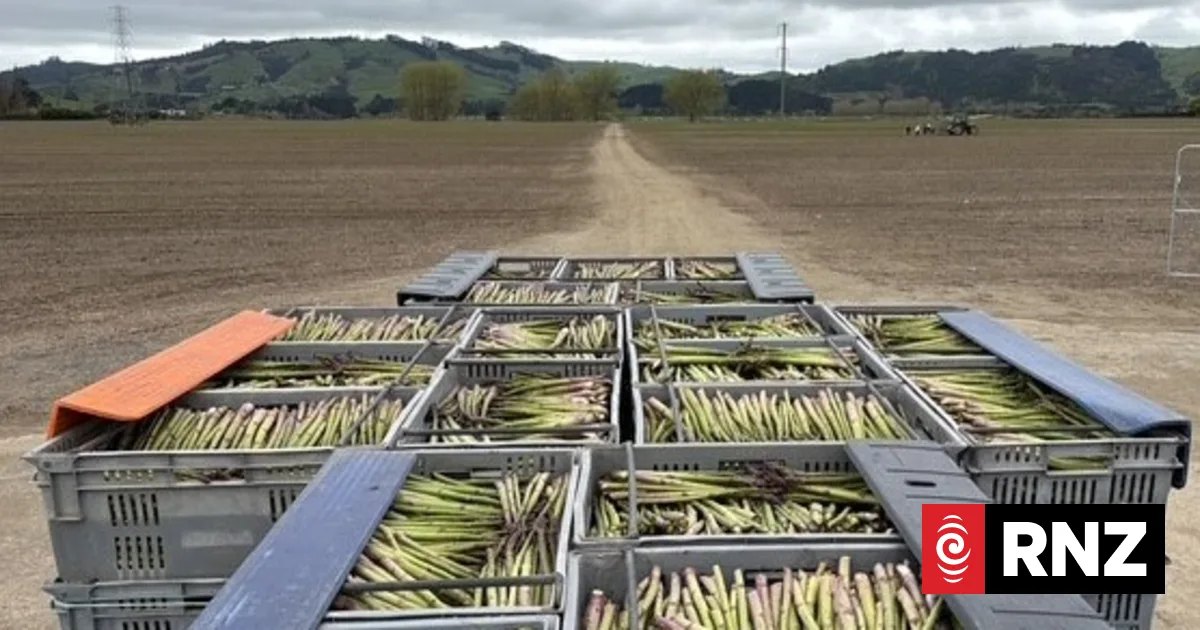
Asparagus pickers at a Cambridge farm in Waikato during the early 2026 harvest.
SUPPLIED/Andrew Keaney
"Weather's been perfect. We've had warm nights, warm days and we've been off to a boomer start," he said.
"It's a very short window, I think because it's not around all year, people get excited about it."
But the higher costs of diesel, fuel-related freight and fertiliser this year were casting a shadow over this season for many growers and farmers in New Zealand.
Keaney said its teams were working to be fuel-efficient, like running full not half loads at a time, but it was difficult to balance this with protecting perishable fresh produce.
"I just close my eyes when I fill up at the petrol station, unfortunately in this game, there's just absolutely nothing we can do about it.
"It's something we can't avoid, and we've just got to grin and bear it."
A Waikato grower says he 'closes his eyes' when filling up his farm vehicle fuel tanks during the asparagus 2026 harvest.
SUPPLIED/Andrew Keaney
Stats NZ figures showed diesel prices had risen 56 percent in the year to September, and petrol prices up 24 percent, amid global supply chain disruptions to key farm inputs from war in the Persian Gulf.
Keaney said it supplied product nationwide in the early stage of the season, before the South Island supplies came on-stream.
"As most growers will know, the cost of freight these days and the fuel adjustment factors that are associated with freight at the moment, the least distances we need to send our product, the better."
Freight companies, rural contractors and logistics firms were applying extra Fuel Adjustment Factor (FAF) surcharges to their customers, including food producers, to cover increased fuel costs.
Food industry consultant Glenn Forsyth, known colloquially as the "Minister of Fruit and Vege" to First Up listeners, told RNZ, some national carriers were adding 40 percent FAF rates to growers' invoices, on top of existing charges.
Keaney said it was not possible to pass on these costs further, especially with other cheap vegetables in the marketplace.
"That's the tough part about it, in our game, is that we can't pass that cost on to our customers.
"Whereas our freight service providers, they put their freight rates up, they apply a fuel adjustment factor which they pass on to us, which is great for them. But it's very, very difficult, nigh on impossible for us to be able to pass that on to our customers.
"We just have to meet the market with fresh product."
Keaney said harvest volumes were already ahead of last year's, which was "good in some ways, but bad in others," because there were good prices in the marketplace for other seasonal vegetables, including brocolli, cauliflower and cabbage.
"Like most vegetable growers around the country will relate to, there's an awash of vegetables available and there's very good buying for consumers in the marketplace right now."
He said asparagus harvests were particularly labour intensive, and labour was its biggest individual cost.
Keaney said asparagus was a wonderfully convenient and versatile vegetable that was easy to cook by roasting, barbecue or boiling.
He said pricing was reasonable for shoppers to date, ranging from between $4-$6 a bunch.
Meanwhile, a spokesperson for the New Zealand Vegetable Council said growers' bottom lines must have gotten tighter, if produce prices were dropping while inputs like fuel and fertiliser were increasing.
He said the season was off to a good start.
"Asparagus from the south is underway, as of last week. So yes, supply is increasing and retail price is dropping, so it's great value.
"In terms of supply of other vegetables, yes, growing conditions have been kind, so there's lots about at great prices."
Keaney said New Zealand no longer exported asparagus. Importing asparagus from usual top market the United States continued to decline since around 2018.
Other countries worldwide explored fuel relief options to support its agricultural and aquaculture producers, while New Zealand did not subsidise agriculture as such.
For example, the United States Department of Agriculture just this week announced it would put $14.1 billion dollars towards a one-off fuel relief payment for farmers in the middle of their autumn season harvests.
Secretary of agriculture, Brooke L. Rollins said it was to provide relief during "temporary market disruptions and increased input costs."
Some European Union countries could and were offering fuel aid for agriculture, including the Irish government back in April deciding to allocate $197 million (€100 million) towards a fuel support scheme for farmers and fishers, as well as reducing green diesel excise.
Slovenia had fuel grants for agriculture, fishing and aquaculture, duties in Greece, and some tax relief in the United Kingdom too.